Walking Toward a New Canvas
9 月 25, 2026
How connected care helped a Travis County painter get back on his feet and back to his art
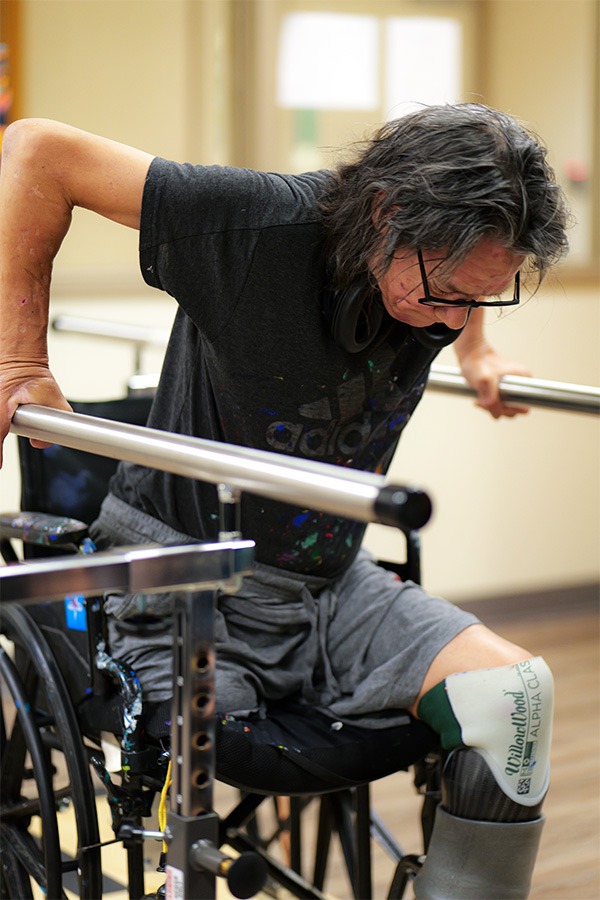
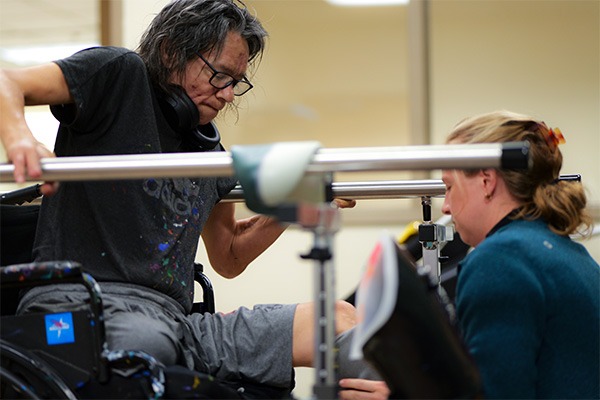
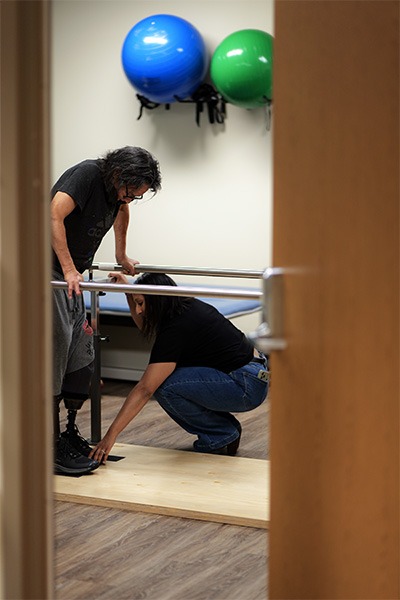
When Michael “Indio” Markie arrived for his physical medicine and rehabilitation appointment at Central Health’s Clinical Education Center in August, the plan was for the 53-year-old Travis County resident to take a few steps with his prosthetic legs.
The appointment went normal at first.
But then, it took a dramatic turn.
At some point—maybe it was the tenth step, or it could have been the twentieth—Dr. Neha Shah began to wonder if Markie was going to walk out of the building.
With both hands on his walker, Markie hit his stride and kept going. He was halfway down the hall before he called it quits.
“That was the farthest I’ve ever seen him walk,” said Dr. Shah, who leads the physical medicine and rehabilitation specialty service at Central Health. “I mean, that was truly amazing.”
In hindsight, it was easy to see what drove him.
Understanding Health Care
Markie’s life changed when his health drastically deteriorated in 2025—the result of being out on the street for over a decade. A serious bone infection led to amputations of both of his legs, parts of his jaw, the loss of his teeth, and two of his fingers.
As a street painter, Markie relied on his index and middle fingers to hold a brush.
Losing them was akin to losing his soul.
Eventually, though, while he realized his life would be different, he still found fulfillment in the things he loved. Central Health helped him gain access to health care through MAP (the Central Health Medical Access Program), a coverage plan for Travis County residents with low income.
And MAP coverage allowed Markie to finally take his health seriously.
First, the Central Health transitions of care team enrolled him in a skilled nursing facility, which afforded him physical and occupational therapy and primary care access. Then came a referral to Central Health’s palliative care program, which led to appointments with a behavioral health therapist and a psychiatrist. Another referral established him with physical medicine and rehabilitation.
Next, a physician referred him to Hanger Clinic, an in-network provider of orthotic and prosthetic care. There, Markie was able to secure two prosthetics for his legs and an adaptive brace for his right hand. The clinic also supported his rehabilitation efforts—from standing to walking.
“For the most part,” said Christopher Martin, Markie’s advanced practice provider with Central Health’s transitions of care team, “he has stayed really positive and doesn’t really let things get in his way. He just adapts.”
Specialists at Hanger Clinic adjusted Markie’s hand brace so that he could tighten a paintbrush through a small circular hole. A year after his amputations, it allowed him to paint freely again.
“I was nervous,” Markie said. “It was like seeing somebody you hadn’t seen in a long time. Thankfully, I just picked up right back where I left off.”
Systemwide Care
Alejandrina de Bary, Central Health’s community health worker lead on the post-acute team, spearheaded Markie’s navigation into the Central Health system, from his initial hospital discharge in February 2025 to his referral with the transitions of care team and his admission to Heritage Park, a rehabilitation and skilled nursing facility.
“I worked closely with him at Heritage Park and our care team to monitor his progress and coordinate services—to make sure there were no barriers to his care, and also to support his discharge planning,” de Bary said.
Care Connected
Central Health’s behavioral health care team stepped in to give Markie time and space to heal in his own way.
April Collmer, an advanced palliative hospice social worker who specializes in mental health counseling and emotional support, provided human feedback that made him feel whole.
“I worked to help him find insight and clarity into his values and what’s most important to him and what brings him meaning in life,” Collmer said.
On The Road To Recovery
At some point, Markie’s appointments at physical medicine and rehabilitation became measuring sticks for his progress.
Early on, Markie asked Dr. Shah a lot of questions. Could she explain his diagnosis? Could she give him a timeline for recovery? What would it take to walk with prosthetic limbs?
Dr. Shah followed by helping him understand his conditions before building out a robust care navigation plan and level-setting his expectations.
“As he progressed through the program,” she said, “he was really engaged in his care and motivated to continue to work on getting better.”
In one of his appointments, Markie brought a bag full of his canvases, small and large. Each painting showcased a complex view of his life, often in vivid colors.
“We were in awe of his talent and how much he could do with a passive prosthetic,” she said.
Looking to the Future
In July 2026, thanks to de Bary’s work, Markie was successfully enrolled in Medicaid.
He’s since been approved for permanent supportive housing through the Austin Housing Authority, which will see him exit nursing care at Heritage Park. He’s also been approved for disability income.
In the meantime, Markie continues to focus on rehabilitation and build strength with his prosthetics. He’s hopeful for a day when he can open his own studio.
Maybe that day is not so far away.
“The first time I met Indio, he was scared, he was angry, he was grieving,” Dr. Shah said. “That’s very normal after losing a part of your body. But over time, he became calmer, more collected, and very hopeful. That’s one of the best outcomes you can have for a patient.”