El cuidado comienza al ser comprendido
8 de mayo de 2026
Language support, trusted guidance, and community outreach are helping Asian families access care with confidence.
It may sound easy enough: When you are hurt or sick, go get health care. But within some cultures and communities, it’s not always so simple.
Kathy Trinh understands this completely.
Before she became a Community Health Navigator (CHN) for the Austin Asian Community Health Initiative (AACHI) in 2022, she was part-owner of a nail salon and worked in the industry for about 21 years. That’s where she first realized there was a problem.
“(My colleagues) often told me, ‘I don’t want to go because if you go, you have to find out that you’re sick,’” said Trinh, who is Vietnamese.
This is one of the primary reasons why Trinh, 44, switched careers.
“The health is more important than anything,” she says.
She’s now one of five CHNs working with AACHI, an organization that partnered in 2025 with Central Health to provide outreach and education to Vietnamese, Korean, and Burmese communities in Travis County.
“We’re helping folks navigate health care,” said Lucy Nguyen, AACHI’s program director. “We make sure people have insurance coverage and help them get covered by ACA, private insurance, and benefits. If those things aren’t available, then we help them apply for Central Health’s Medical Access Program (MAP).”
Why Health Navigators Are Necessary
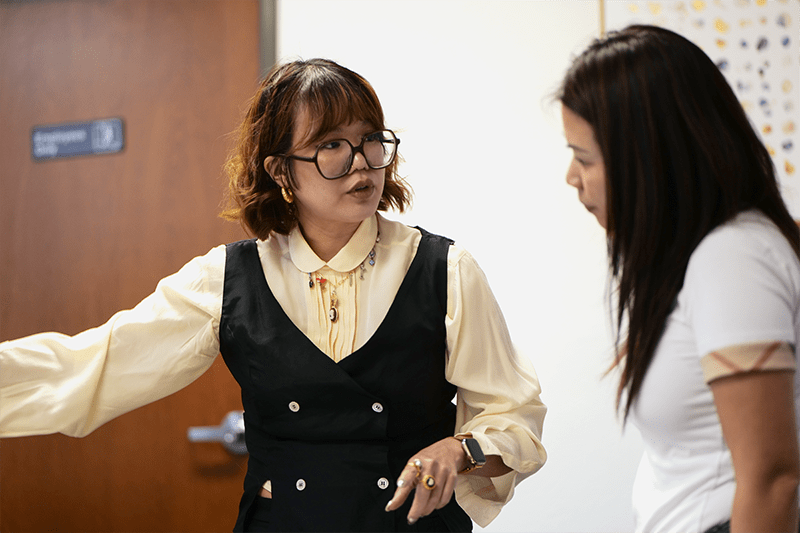
When Nguyen was about 12 years old and living in Fort Worth, her Vietnamese parents owned a business. One day, her appendix was about to burst. The family rushed her to the hospital, only to realize they couldn’t understand the procedure that was being done.
That placed Nguyen in an unenviable position as a child: to become the family’s de facto health navigator. And how exactly does a child explain complex medical services?
“I didn’t even know how to translate the word ‘appendix,’” she said.
Nguyen eventually went to college and earned advanced degrees from Texas A&M University before eventually landing at AACHI in 2019. By then, she knew what representation meant for communities like the one AACHI serves.
“I was compelled with the work that was being done here,” she said.
Translation support is key to what AACHI provides for the Asian community if that means taking the burden of health care navigation away from a child, Nguyen says, it’s a win. Clients at AACHI might speak Vietnamese, Korean, Mandarin, Burmese, or Arabic, along with several other languages.
That ultimately means community health navigators are the lifeblood of AACHI’s work. They are licensed Community Health Workers (CHW) who provide help such as patient advocacy, translation support, referrals to local resources, health education, and eligibility assistance. AACHI distributes food, provides vaccinations, and during the school season it even helps with school supplies.
Navigators like Trinh go the extra mile to help clients. That might mean meeting a client at the grocery store, the laundromat, or even the Buddhist Temple. Sometimes, though, it also means answering messages on Facebook.
And Trinh is “the Queen of Facebook,” she says.
“I have people who call me, text me, and message from those different channels,” she said.
Sometimes, that kind of work can lead to citizenship, as it did in 2024 when Trinh helped a stage-four lung cancer patient get naturalized in his own home. There are also important tasks like helping patients open their mail, which sounds simple until you realize that most patients need language support.
“Sometimes they receive mail and don’t know what to do with it,” Trinh said. “(A patient) may need to renew their SNAP benefits and won’t understand how to pick out the mail. So that’s where we come in.”
Serving A Community
The majority of AACHI’s clients fall below the Federal Poverty Level (FPL), so CHN’s work to identity health care needs. If eligibility is met, patients can be enrolled with MAP or MAP Basic, health care options for Travis County residents with low income. Any first appointment starts first with a client being screened for social determinants of health.
AACHI served about 350 clients and their families in 2025¾ though it’s important to note that while AACHI only intakes adults it often winds up supporting the whole family¾and has long-term plans to further its reach into neighboring areas like Williamson County.
“Our community is strongest when people can get care they understand and trust,” Central Health CEO Dr. Patrick Lee said. “At Central Health, we’re honored to work with AACHI to better serve AAPI residents in Travis County and to help ensure that language, culture, or confusion about the system never stand in the way of someone getting the care they need.”
Forging Ahead
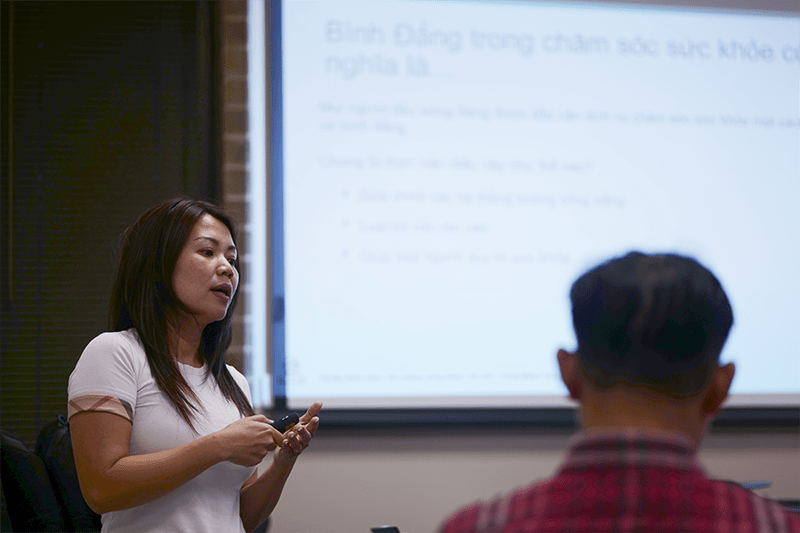
AACHI’s relationship to Central Health has spanned more than a decade. In April, Central Health came to AACHI with its neighborhood-based Community Health Champions program.
The Health Champions began in 2016 as a multi-week symposium of workshops and lessons where a selection of Travis County residents learned about the health care system and worked to address health disparities.
In 2023, however, Central Health found there were still gaps.
Some communities couldn’t experience the Health Champions program because it was entirely in English. In response to that need, Central Health piloted its neighborhood-based program in Rundberg, a community in Austin with a significant population of Spanish-speakers, and ran the one-day event at Navarro High School in Spanish.
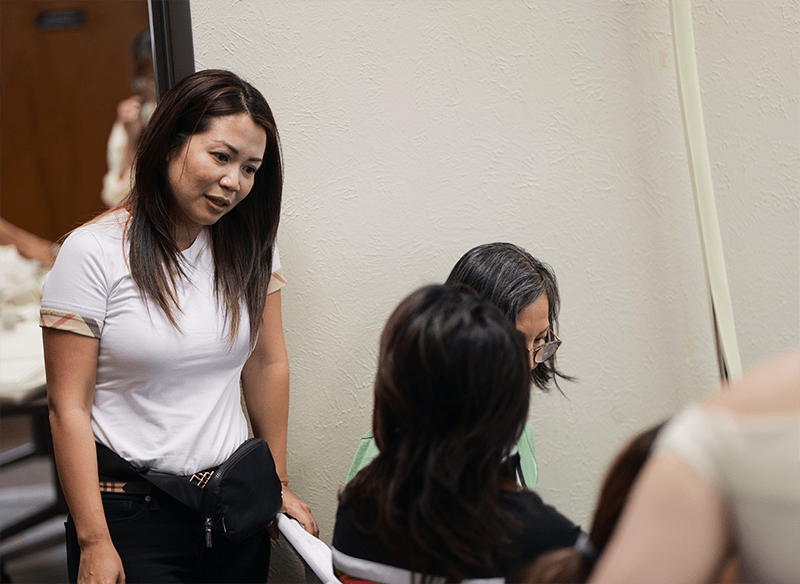
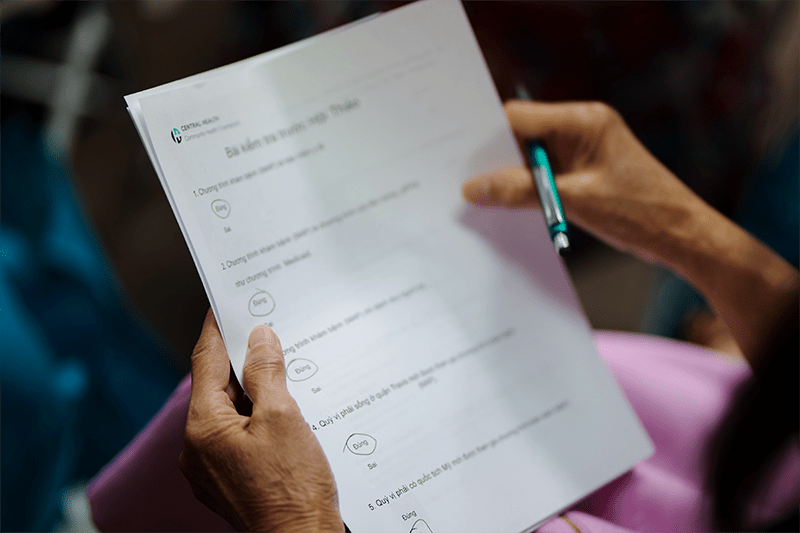
After that success and others, Central Health came to AACHI and organized another neighborhood-based program entirely in Vietnamese. Trinh led instruction in front of a group of roughly 15 Vietnamese-speaking community members.
It reminded Nguyen why she continues her service to this community.
“The folks here now have a voice to learn more about Central Health and the health system in general,” she said.
And for Trinh, who moved into the health care field because of her own experiences, it reinforced ideals that continue to drive her work.
“We work to get people’s lives back to balance,” she said.
The History of The Austin Asian Community Health Initiative
Before AACHI, there was the Asian American Resource Center (AARC), an Austin nonprofit that was founded in 2006 by the Network of Asian American Organizations and sought to support the creation of a facility that could provide spaces, services, resources, and programs through an Asian American Pacific Islander (AAPI) perspective. It took some time, however, for AARC’s leaders to raise funds for their own space within the city of Austin. By 2013, the center began operating out of a facility under the City of Austin Parks and Recreation Department.
Three years later, AARC received a $50,000 grant from Austin Public Health to fund a pilot that would become AACHI’s CHN program (independent of AARC). That program, which built on a commitment to health equity work, expanded access to health care and social service needs for AAPI.
“We want to keep helping people,” Nguyen, 34, said.