नयाँ अध्याय पकाउँदै
जुलाई १०, २०२६
How Central Health helped Kafaren Fairly reclaim her health, home, and passion for food
Kafaren Fairly believes in the power of food.
“It’s my passion,” she says.
As a lifelong cook from Mississippi, her culinary background has taken her to countless kitchens in the South, where she’s fed thousands of people. Shrimp dishes, chicken and beef entrees, even homemade mac-and-cheese. Anything you can think of, she’s created it.
But her specialty is sauteed vegetables. When she’s at home and her creativity is flowing, she’ll splash a bit of lemon pepper and paprika on zucchini, squash, cabbage, or peas.
“That’s my little concoction,” she says.
Kafaren delivers food, she says, to bring love into the world.
But a year ago, after moving to Austin and then spending a brief stint out on the streets on her own, she faced a challenge well beyond the kitchen.
Dealing with Chronic Issues
When Kafaren, 60, arrived in Austin last June, her health was deteriorating. She had an unstable foot, Type 2 diabetes, and diabetic retinopathy. Notably, she was experiencing eye floaters, which are small specks of cloudy material that impact vision, and had cataracts in both eyes.
She had spent all her life in Biloxi, Mississippi with Kevin, her husband of 39 years, and their children. It was Thanksgiving a few years ago with the family when she broke her ankle, prompting surgery and a few screws jutted into the bone. Years later, it made her shaky.
Now in Austin, Kafaren knew she needed help. Mere days into her tenure as a resident of Travis County, she called 2-1-1, a free social service hotline for non-emergencies, and was advised to visit the Sunrise Communities Homeless Navigation Center. A short time later, she enrolled in MAP (the Medical Access Program), a coverage option by Central Health for Travis County residents with low income.
By August, Kafaren’s need for health care outweighed the services she had been given. It prompted her to make the hardest decision of her life: entering the Eighth Street Shelter, a facility for unhoused women and transgender people living in Austin.
“Everyone was so hurt by me making that choice,” she said, “but I had to do that to get to where I am now.”
CommUnityCare Health Centers, Central Health’s ambulatory care partner and a Federally Qualified Health Center (FQHC), utilizes a street medicine team to provide care to people in need at places like campsites, the Austin Resource Center for the Homeless (ARCH), the Marshalling Yard, and the Eighth Street Shelter. There’s also the Central Health Bridge Team, which is dedicated to helping Travis County people who are unhoused. The Central Health system works together to provide wraparound care, which includes social and other support services.
At the time, Kafaren was using a cane to walk.
“She had a complicated personal and social situation that led to homelessness and was staying at 8th street,” said Dr. Feba Thomas, who directed Kafaren’s care and is also Central Health’s Director of Informatics.
Making Changes
Before Dr. Thomas did a single thing, she looked at Kafaren and asked her a question.
“What are your priorities?”
“I think when you’re unhoused, you don’t have autonomy,” Dr. Thomas said. “Society and different people tell you to do X, Y, and Z to get your needs met. You can’t sit down. You can’t camp. You can’t go to the bathroom. For me, respecting people and treating them like humans with autonomy is important.”
It was a question Kafaren did not consider initially, either. What were her priorities? For years, visits to the doctor weren’t enjoyable. They felt empty, as if she wasn’t being seen or heard. In Mississippi, where she held insurance coverage through the health insurance marketplace, she said she was cast aside, unable to make routine appointments.
Maybe all of this was a reason for her depression. But in an instant, that all changed. The past seemed so far in the rearview.
Inside the exam room, Dr. Thomas treated Kafaren’s knee to reduce inflammation and pain.
Within days, the ball began to roll.
First came appointments with behavioral health providers, and a referral to Integral Care. Next came cataract surgery to improve Kafaren’s vision. More referrals followed, forwarding her to specialists that could help her eyes and feet.
There were appointments at the Capital Plaza Specialty Clinic’s bridge clinic and the Central Health East Austin Specialty Clinic, as well as health care pitstops at the ARCH to receive primary care through CommUnityCare Health Centers providers.
All this health care was covered under MAP.
“She saved my life,” Kafaren said of Dr. Thomas.
Moving Forward
When Kafaren was on the road toward better health, she found a job through The University of Texas as a cook for Jester City Limits, a university housing and dining hall.
And that passion for food? It bubbled back to the surface.
“I’ve been a cook all my life,” she said.
Eventually, Kafaren found permanent footing elsewhere, too.
At the start of the new year, she met with a Central Health case manager to complete a Social Security Disability Insurance (SSDI) application. After being approved in February, she found housing in March.
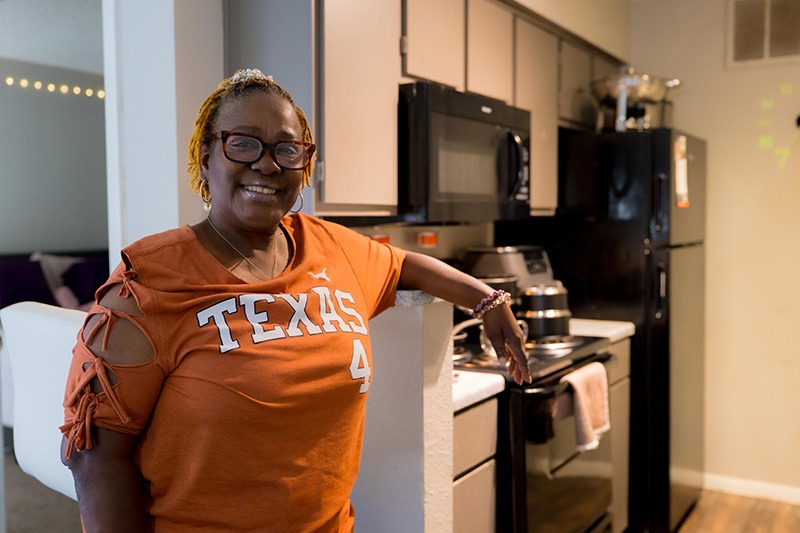
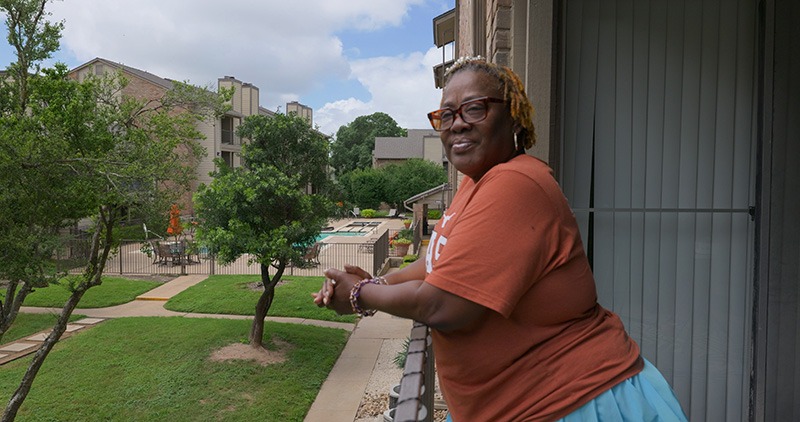
By June, Kafaren was comfortably moved into a one-bedroom apartment. Outside her place sat two lawn chairs and a few plants. Inside was a futon and a television. A Bible laid neatly on an ottoman. Kafaren’s biggest point of pride, though? Her refrigerator.
Inside the door revealed orderly stacks of food and drink.
Just the other night, she made “Wemby-tizers,” chicken and vegetable kabobs named after San Antonio Spurs star Victor Wembanyama.
“I don’t want to get off track,” she said of the Spurs, who lost in the NBA Finals to the New York Knicks, 4-1, “but I’m hurt (by the Spurs).”
The basketball score notwithstanding, Kafaren was in good spirits.
She’s healthy, happy, and ready to cook again.
“Austin is my home now,” she said.